
Research
I work across biological scales to understand how plant responses to disturbance can lead to shifts in plant communities and cascading effects on ecosystem-level processes.

My work takes place in the tallgrass prairies of North America and savannas of South Africa and Kenya. I am particularly interested in plant physiological responses to disturbance such as fire, drought, and herbivory. Changes in disturbance regimes can cause large-scale shifts in vegetation structure and composition and, in turn, shift community-level patterns of carbon assimilation and water-use strategies. Linking plant physiology with community change can deepen our understanding of ecosystem responses to climate and land-use change.
Projects
Herbivore impacts on plant physiology
The relative impacts of top-down forces, such as herbivory and fire, versus bottom-up forces, including water and nutrient availability in shaping grasslands and savannas has been debated for decades. However, these drivers do not act in isolation, and we still have limited understanding of how multiple stressors interact to impact plant physiology, growth, and ecosystem dynamics. Across multiple projects in African savannas and North American prairies, we are exploring (1) how rainfall and large mammalian herbivory interact to affect tree and grass growth and physiology and (2) how variation in plant responses to disturbance scales up to influence population dynamics and community structure. To answer these questions, we combine long-term herbivore exclusion experiments with in situ measurements of plant physiology, including gas exchange and water potential. Ultimately, our goal is to understand how large herbivores influence the resilience of grassland and savanna ecosystems to drought.


Relevant Publications:
-
Wedel ER, Rodriguez-Blash T, Nippert JB. 2026. Bison grazing increases grass foliar nutrients and drought tolerance at fine spatial scales. Plant and Soil, 1-16. https://doi.org/10.1007/s11104-026-08422-w
Drivers of tree cover in African savannas
Mapping and predicting changes in tree cover is a central goal of savanna ecology. Our research spans projects in South Africa and Kenya that examine the drivers of variation in savanna tree growth and cover. In South Africa, we are using an in situ rainfall manipulation experiment to isolate the effects of rainfall intensity, deep soil water availability, and growing season length on the growth of savanna tree sapling growth. This work will help identify the mechanisms driving increases in tree cover with increases in mean annual rainfall. In Kenya, we are using high-resolution LiDAR data to understand the drivers of tree cover and post-drought recovery following the severe 2022 drought.


Woody encroachment in grasslands and savannas
The expansion of trees and shrubs into historically grass-dominated systems, known as woody encroachment, is one of the greatest conservation threats to grasslands and savannas worldwide. In tallgrass prairies and many Afican savannas, this phenomenon is driven by clonal shrubs, which pose a significant management challenge because of their ability to resprout following fire or brush clearing. We are working to understand the physiological strategies of woody encroaching species and effective management techniques to control their spread. Our research has shown that encroaching shrubs are morphologically and physiologically diverse and suggests an equally diverse management approach may be required to combat their spread. We have also shown that brush clearing can be and effective removal strategy, but targeted, repeated management is necessary to increase the long-term success of woody removal.

Control plot

Cleared plot

Photos: (left, middle) Mopane removal experiment at Mthimkhulu Game Reserve, South Africa in collaboration with the South African Environmental Obersvation Network and the Mthimkhulu community. (right) Woody removal experiment at Konza Prairie Biological Station, KS, USA.
Relevant Publications:
-
O'Connor RC, Wilcox KR, Koerner SE, Komatsu KJ, Wedel ER, Avolio ML. 2026. Cutting, herbicide and fire: a case study for managing woody plants in tallgrass prairie. Restoration Ecology, e70403. https://doi.org/10.1111/rec.70403
-
Wedel ER, Ratajczak Z, +Tooley EG, Nippert JB. 2025. Divergent resource-use strategies of encroaching shrubs: Can traits predict encroachment success in tallgrass prairie? Journal of Ecology, 113(2), 339-352. https://doi.org/10.1111/1365-2745.14456
-
Wedel ER, Nippert JB, O’Connor RC, Nkuna P, Swemmer A. 2024. Repeated clearing as a mechanism for savanna recovery following bush encroachment. Journal of Applied Ecology, 61(7), 1520-1530. https://doi.org/10.1111/1365-2664.14666
-
Wedel ER, Nippert JB, Hartnett DC. 2021. Fire and browsing interact to alter intra-clonal stem dynamics of an encroaching shrub in tallgrass prairie. Oecologia, 196(4), 1-10. https://doi.org/10.1007/s00442-021-04980-1
-
Wedel ER, O’Keefe K, Nippert JB, Hoch B, O’Connor RC. 2021. Spatio-temporal differences in leaf physiology are associated with fire, not drought, in a clonally integrated shrub. AoB Plants, 13(4), plab037. https://doi.org/10.1093/aobpla/plab037
Grass physiology and macroecology
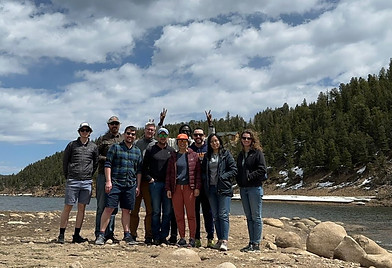
Grass-dominated ecosystems cover ~25% of the terrestrial surface, harbor tremendous amounts of biodiversity, and help regulate global carbon and water cycling. Despite their widespread distribution, grasses are underrepresented in trait databases, limiting our ability to synthesize and predict changes in these widely distributed but often overlooked ecosystems. Grasses are typically grouped into C3 or C4 functional types, which ignores important diversity within the C4 functional group. The grassland macroecology group is developing a novel framework to group grass function based on evolutionary lineage, rather than photosynthetic type. This project has connected me with highly collaborative group of grassland ecophysiologists, expanded my understanding of evolutionary ecology, and provided me with mentorship opportunities with MSc students.
Relevant Publications:
-
Pau S, Slapikas R, Ho CL, Bayliss S, Donnelly R, Abdullahi A, Helliker B, Nippert J, Riley W, Still C, Wedel E, Griffith D. 2025. Hyperspectral leaf reflectance of grasses varies with evolutionary lineage more than site. Ecosphere, 16(4), e70257. https://doi.org/10.1002/ecs2.70257
-
Donnelly RC, Nippert JB, Wedel ER, Ferguson CJ. 2024. Grass leaf structural and stomatal trait responses to climate gradients assessed over the 20th century and across the Great Plains, USA. AoB Plants, 16(5), plae055. https://doi.org/10.1093/aobpla/plae055
-
Donnelly RC, Wedel ER, Taylor JH, Nippert JB, Helliker B, Riley W, Still CJ, Griffith DM. 2023. Evolutionary lineage explains trait variation among 75 coexisting grass species. New Phytologist, 239(3), 875-887. https://doi.org/10.1111/nph.18983