Woody encroachment in tallgrass prairie
Physiological strategies of clonal encroaching shrubs
Konza Prairie Biological Station, Manhattan, KS
After the conversion of grasslands to row crop agriculture, woody encroachment poses one of the greatest threats to grassland conservation. This phenomenon is driven by the expansion of native shrubs, but not all species are expanding at the same rate. In this study, we characterized the growth and resource-use strategies of the most abundant encroaching shrubs at Konza Prairie. We found that the two most rapidly encroaching species had contrasting physiological strategies: tall species that form dense thickets, shade out grasses, and suppress fire vs. shorter, drought-tolerant species that coexist with grasses. Our study highlights the diversity of encroaching shrubs in mesic grasslands and suggests an equally diverse management approach may be required to combat their spread. By understanding the physiological strategies of these species, we can better predict which

species are likely to increase under future climate and land-use scenarios and develop more targeted management strategies to mitigate encroachment.
Collaborators: Dr. Jesse Nippert (KSU), Dr. Zak Ratajczak (KSU), Greg Tooley (CSU)
Combined effects of herbicide, brush clearing, and fire on woody encroachment
Konza Prairie Biological Station, Manhattan, KS
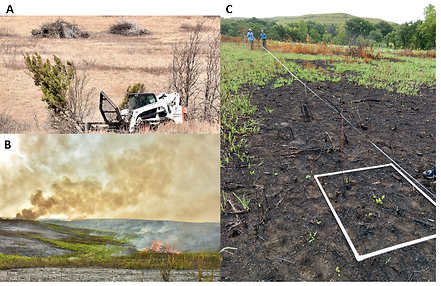
Clonal shrubs encroaching into grasslands pose a significant management challenge because of their ability to resprout following fire or brush clearing. In this experiment, we evaluated the effectiveness of herbicide application, mechanical brush clearing, and annual prescribed fire in reducing woody cover. While treatments effectively decreased the abundance of non-resprouting trees, clonal shrubs reestablished. In areas where fire was intense enough to kill shrub buds, shrubs declined and forbs became dominant. These results suggest repeated management is required to achieve long-term reductions in shrub cover, and that perennial grasses may not quickly reestablish following shrub removal.
Collaborators: Dr. Rory O'Connor (USDA), Dr. Meghan Avolio (John Hopkins), Dr. Kevin Wilcox (UNCG), Dr. Kim Komatsu (UNCG), Dr. Sally Koerner (UNCG)